

Call us: 866-RITA-TOW

Last Updated: October 26, 2026
Quick Summary
To change a tire on a highway, pull as far right as you can on level ground, set the parking brake, turn on hazard lights and place wheel wedges before lifting. Loosen the lug nuts a quarter turn while the tire is still on the ground, raise the vehicle at the jack point in your owner’s manual, swap the tire, then tighten the nuts fully in a crisscross pattern. Never put any part of your body under the vehicle.
- The Oklahoma Turnpike Authority advises drivers not to change a flat on the highway at all.
- You need five tools: spare tire, lug wrench, jack, wheel wedges and owner’s manual.
- A spare older than about six years is a liability, not a backup.
- A practiced driver changes a tire in about 15 to 20 minutes on a safe shoulder.
- Keep a temporary spare under its limits, typically 50 mph and 50 to 70 miles.
Table of Contents
- What to Do With a Flat Tire on the Highway
- Tools Needed to Change a Tire
- How to Change a Tire Safely: 7 Steps
- How Long Does It Take to Change a Tire?
- Frequently Asked Questions
What to Do With a Flat Tire on the Highway
A flat tire on the highway is a safety emergency before it is a repair job.
- Keep both hands on the wheel and ease off the gas. Do not brake hard.
- Turn on your hazard lights immediately.
- Look for an exit, a rest area, or a wide shoulder. A parking lot beats a shoulder every time.
- Pull as far right as you can and stop on level ground.
- Set the parking brake and turn the wheels away from traffic.
If traffic is heavy, visibility is poor, or you are on a bridge or in a narrow work zone, stay buckled in and call for help.
If you do decide to handle it yourself, see the roadside services available to you before you start. For the wider playbook, read our guide on how to handle a highway breakdown safely.
Tools Needed to Change a Tire
You need five things, and most drivers are missing at least one. Check your trunk before you need it.
- Spare tire, inflated and not aged out
- Lug wrench that fits your wheel nuts
- Scissor jack or floor jack from your tool kit
A flashlight, gloves, reflective triangle, and tire pressure gauge earn their space too, the spare may be 20 psi low.
Check the spare before the trip, not on the shoulder
A spare that has sat in your trunk for 15 years can fail within miles of installation, one documented case describes an aged spare failing catastrophically within 25 miles. Check its date and pressure twice a year: the four-digit sidewall code gives the week and year, and a spare older than about six years is a liability, not a backup.
What to do if tools or a usable spare are missing
If you find no jack, no lug wrench, or a spare that is flat, cracked, or missing, the roadside change is over before it starts. Your options, in order of preference:
- Call roadside assistance or highway patrol and stay in the vehicle with your seatbelt on until help arrives. Do not stand behind or beside the car.
- Use a tire inflator or sealant kit only for a simple tread puncture and only if the vehicle came with a kit designed for it. These kits are unsuitable for sidewall damage, large punctures, or a tire that has run flat and been damaged internally.
- Do not improvise a jack from rocks, boards, or another vehicle’s bumper jack. The jack point is engineered for a specific jack, and a mismatch can drop the vehicle.
Watch Out
A can of sealant is not a repair. It is a way to limp to a tire shop. Tell the technician you used it, because the tire may need to be replaced rather than patched, and the sealant can damage the TPMS sensor.
A can of sealant is not a repair. It is a way to limp to a tire shop. Tell the technician you used it, because the tire may need to be replaced rather than patched, and the sealant can damage the TPMS sensor.
Vehicle-specific jack points and electronic systems
Your owner’s manual is the authority on where to lift. Some vehicles have a single reinforced pinch weld; others have designated lift pads, and lifting in the wrong spot can crush a rocker panel or a fuel line. Three cases deserve extra caution:
- Air suspension: lifting one corner can confuse the leveling system. Many vehicles have a jack mode that must be enabled first; check the manual.
- Electric vehicles: the battery pack runs under the floor between the axles, and the jack point is a specific reinforced pad. Lifting on the pack is a costly mistake.
- Space-saver or run-flat spares: run-flats may have no spare at all, and the manual gives the speed and distance limits for limping to a shop.
If the manual is missing, look for the jack point diagram on the jack itself or near the spare well. When in doubt, call for help.
How to Change a Tire Safely: 7 Steps

Work in this order, and never put any part of your body under the vehicle.
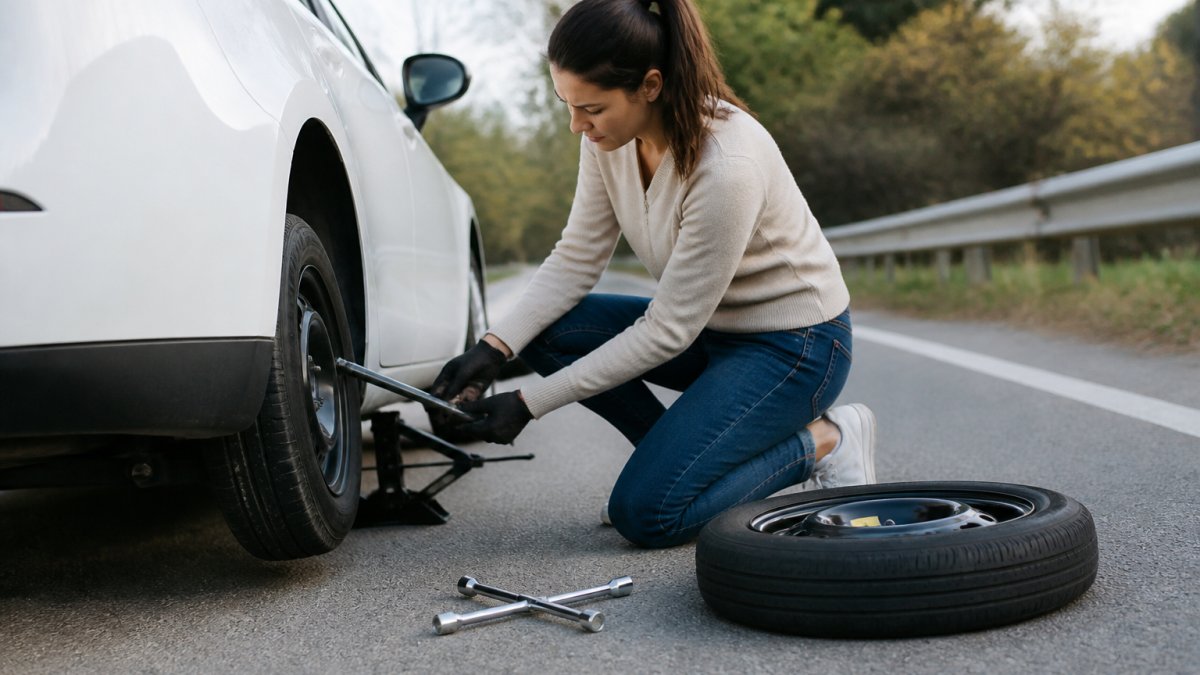
- Park and secure. Level ground, parking brake on, hazard lights flashing, wheel wedges behind the opposite wheel.
- Gather your tools and place them beside you, not inside the trunk.
- Remove the hubcap or wheel cover so you can reach the lug nuts.
- Loosen the lug nuts a quarter turn while the tire is still on the ground. This is the step people skip, and it ruins the job.
- Raise the vehicle at the jack point named in your owner’s manual until the flat clears the ground.
- Swap the tire. Pull the flat off, lift the spare on, and hand-tighten the lug nuts in a star pattern.
- Lower the vehicle, then tighten the nuts fully in a crisscross pattern.
If you reach a step you cannot safely finish, contact professional roadside assistance instead of forcing it.
Here is the seven-step order to follow, and never put any part of your body under the vehicle.
| Step | What to do |
|---|---|
| 1 | Park and secure: level ground, parking brake, hazards, wheel wedges |
| 2 | Gather your tools and place them beside you |
| 3 | Remove the hubcap or wheel cover |
| 4 | Loosen the lug nuts a quarter turn while tire is on the ground |
| 5 | Raise the vehicle at the jack point in your owner’s manual |
| 6 | Swap the tire and hand-tighten lug nuts in a star pattern |
| 7 | Lower the vehicle, then tighten nuts fully in a crisscross pattern |
How Long Does It Take to Change a Tire?
A practiced driver changes a tire in about 15 to 20 minutes on a safe shoulder. If you are deciding whether to wait or call for help, our beginner’s guide to towing and roadside services explains how roadside assistance works and what is included.
Add time for conditions: heavy traffic or poor visibility means do not attempt it; missing tools or a flat spare means the job is over before it starts; rusty or over-torqued lug nuts mean expect a fight, and bring leverage, not brute force.
When not to change a tire on the highway
Treat this as a stop list. If any of these is true, do not get out and do not start the job. Stay buckled in, call for help, and wait.
- The shoulder is narrow, soft, or sloped. A shoulder under about 10 feet wide, or one with a drop-off, gravel, or mud, gives you no safe place to kneel and no stable base for a jack.
- Visibility is poor. Rain, fog, snow, dusk, or a curve or hill crest that hides you from traffic.
- You are on a bridge, in a tunnel, or in a work zone. There is no safe refuge and no room to work.
In any of these cases, get to a safer location if the vehicle can roll, or stay put and call for help if it cannot.
Where occupants should wait
If you cannot reach a safe spot off the roadway:
- Exit from the side away from traffic, meaning the passenger side if you are pulled over to the right.
- Move behind a barrier if one exists, or as far from the travel lane as the terrain allows. Do not stand behind or beside the vehicle, or between the car and oncoming traffic.
- Keep everyone, including children and pets, away from the traffic side if the vehicle is in a live lane. If there is no safe place outside, stay buckled inside with hazards on.
Key Takeaway
On a highway, the safest place for occupants is usually behind a barrier and away from the travel lane, not next to the car. Decide where that is before you open the door.
On a highway, the safest place for occupants is usually behind a barrier and away from the travel lane, not next to the car. Decide where that is before you open the door.
Calling for help and roadside-assistance options
If you are not changing the tire yourself, choose the right call:
- Roadside assistance (your insurer, auto club, or a towing service) for a flat with a usable spare, a dead battery, or a lockout. Many policies cover tire changes on the spot.
- Highway patrol or emergency services if the vehicle is in a live lane, if anyone is injured, or if you feel unsafe. Do not wait to see if the situation improves.
- A tire shop or mobile tire service if the spare is unusable or you want a replacement brought to you.
When you call, give the dispatcher the highway number, direction of travel, the nearest exit or mile marker, and a description of the vehicle.
If you would rather not wait it out yourself, it helps to know what a towing service actually includes, since many cover tire changes on the spot.
A temporary spare is a short-distance fix, not a replacement.
Frequently Asked Questions
Can I change my tire on the highway, or should I call roadside assistance?
You can change a tire on the highway if you reach a safe spot off the travel lane, but the Oklahoma Turnpike Authority advises drivers not to change a flat on the highway itself and to get off the road to a parking lot instead. If traffic is heavy, visibility is poor, or you lack a usable spare and tools, call roadside assistance.
What tools do I need to change a flat tire?
You need a lug wrench or wheel wrench, a jack, wheel wedges or chocks, and a properly inflated spare tire, all usually stored in your vehicle’s tool kit. Check your owner’s manual for the exact jack point and spare location. If any tool is missing or the spare is old, do not attempt the change. A 15-year-old spare in one case study failed within 25 miles of installation.
How long does it take to change a tire?
A practiced driver can change a tire in roughly 15 to 30 minutes once safely parked, but highway conditions, stuck lug nuts, or an unfamiliar jack point can stretch that time. The bigger variable is safety exposure: every extra minute on the shoulder raises risk. If the job is not going smoothly, request roadside help and get back to a safe position.
A flat on the highway is one of the few car problems where the smartest move is often to stop and hand it off. RITA Rescue connects you to certified local tow trucks and technicians 24/7, with live GPS tracking so you can see help coming and upfront diagnostic price quotes before anyone touches your vehicle. Get started with RITA Rescue and turn a roadside emergency into a tracked job with a fixed price.
